The last few months have had me relocating and dealing with the variety of life. I’ve finally gotten some time to wrap some Wistblade projects.
The Summary
I’ve been at the cusp of launching playtesting since September, but decided back in October to wait until I get base-building, economy, product design, general theme and branding, pricing, and just about everything into a state that people can respond to the experience rather than a specific game system.
Art Style
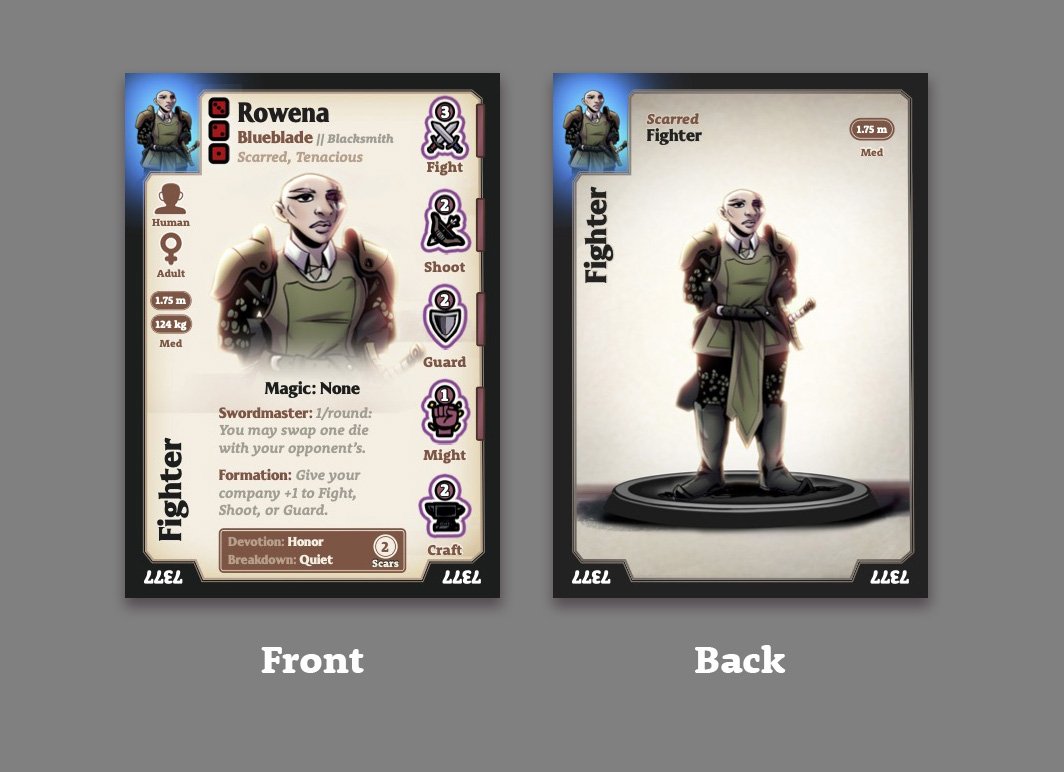
All the placeholder art for Wistblade is from another project I was looking to launch a couple years ago called Character Cache. While I have yet to create new artwork for Wistblade, I’ve explored enough to know I’m going to stick with style similar to Character Cache. The main thing change is I’m going to lean into the “miniature look” more heavily than in the past. Thick limbs, thick weapons, looks like it could exist in real life, and I’m going to add custom bases to each character. That’s the basic style. Maps and Locations art styles not yet fully defined, though. But they likely will NOT be miniature-like. They’ll be more traditional painterly styles most likely like Magic cards.
Basic Look
The game in general will be neutral colored vanillas, grays, browns, and blacks, with important things in full color and vital story points in bright colors (like wounds and conditions).
Branding
I have wanted to hire some fancy artist to make amazing art for the cover of my game, but I finally decided after looking at my bank account that this, too, would need to be sacrificed. Does the game NEED fancy cover art to be successful? I guess we will find out because I’ve nixed it because of budget constraints. A great crowdfund may change it, but if I have a great crowdfund, why not just add more content to the game instead of change its cover? It’s obvious it didn’t need the cover art anyway.
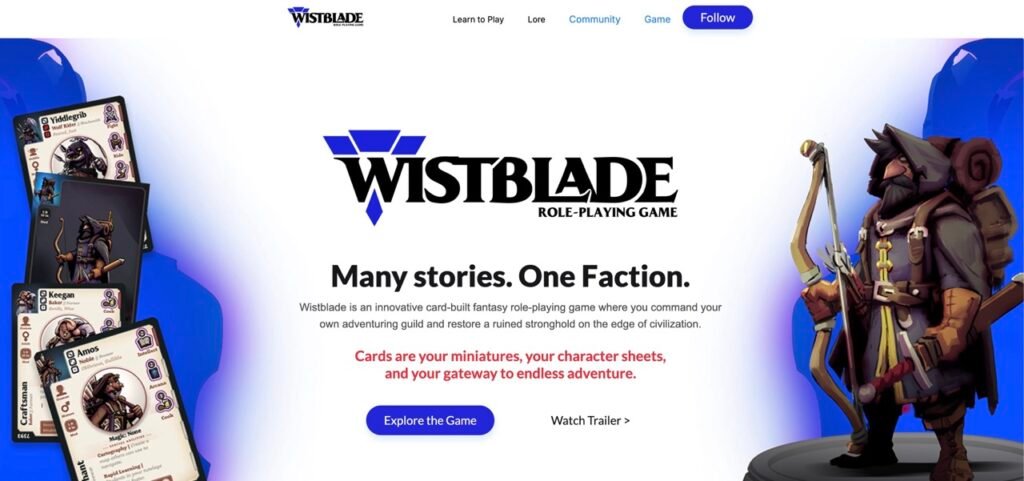
The box will likely feature production art, perhaps taken to another level of polish and definitely a variety of cards. Here’s the first pass at a landing page for WIstblade. The box art will likely look and feel similar to this. Something that highlights the name of the game, a little art, a blast of azure blue, and a lot of white space.
Finishing the Triad Engine
I’ve recently decided to call Wistblade’s game engine the Triad Engine (name still up for debate…). The Triad Engine uses a Universal Symbology, in this case Skill Icons (with some other symbols as well, like “Level Dice” icons), as well as a Universal Medium (in this case cards of the same size), with a Universal Interaction and Layout Language, which defines how the cards get distributed, collected, stored, interacted with, and “expanded” or laid out on the table. Add to this core Triad all the other mechanics that are unique, such as playing multiple characters and gaining new ones via trust, among many other unique mechanics, and you get a complete game engine that does many core role-playing tasks, like story generation, information management, and new player onboarding, much better than traditional pen-and-paper systems.
Much like Magic: the Gathering has universal card types, 5 core colors of magic, and a universal layout on the card, so too does Wistblade try maintain its own internal and intuitive consistency.
The Triad Engine makes for a powerfully simple way to experience a role-playing game, and I’m pleased to announce that it seems to be working (we’ll see what happens in play testing, though!)
Expanding the Play Area
One of the biggest problems I’ve been struggling with has been tabletop space and optimizing the play area for streaming on YouTube. The importance of this has been critical to me. Not only do I love watching stories unfold on YouTube and want to see better and easier-to-understand content, but I also at the time of writing am someone without a following at all and I need as much exposure as I can get. I have less than 100 subscribers to my name on YouTube and less than 300 followers on Instagram (I stopped using IG a long time ago). Whether putting my game’s YouTube optimization as a critical part of the game design is truly critical is up for debate, but thus it has been.
All year I’ve constrained the play area to a 16:9 aspect ratio, and a zoom level that keeps cards readable at 4k. This brought me to a 32 inch wide x 18 inch tall play area. It limits battles to around 40 cards (20 per side). But there’s never been space for your base on this play area. Not even close.
I’ve finally buckled and solved this by just adding a “second screen” so to speak, or doubling the gameplay area width from 32″ to 64″. This fits perfect on a standard folding table with about six inches to spare on all sides. It does mean streamers will need two cameras to capture their base as well as their adventuring parties, and will need to cut between them, but it’s about the best I can do without redefining the game, which is something that I finally decided would destroy its purpose in existing.
Base-building
I’m kind of surprised at how little base-building is a part of many role-playing games. It often feels like a mini-game tacked onto the main game “if you want to try it and see.” But in Wistblade, base-building is one of the core systems. Without it, Wistblade isn’t Wistblade. I have a lot to say on this subject so will save it for another post, but suffice it to say I’ve got it working reasonably well and I hope it will get good reviews from the playtest teams.
Improv Dungeon & Site exploration
The game features three types of location cards: Realms, Landmarks, and Sites. Realms are card-sized overland maps that live in the corner of the play area and primarily define the Biome and the Geography you are in or will encounter based on what direction you choose to travel. Landmarks are points of interests on that map that are chosen by the Game Master. Some examples of Landmarks include cities, towns, ruins, dungeons, and geographic points of interest, among many other options. A Landmark is filled with Sites you can explore. Sites are building or city-block sized locations that each sport events, loot, interesting people, monsters, or other fun things and have a uniquely defined personality tied to the landmark. The Game Master can add additional sites, but exactly how this will work is not yet defined.
Product Design & Pricing
I’ve had a ton of refining on the Product side. If the game isn’t profitable, if it isn’t sellable, if it isn’t understandable and desirable, these are all things that can kill a small business before it starts. I’ve had to reign in a lot of my “nice-to-haves” and focus on the core needs. This, I think, has also made Wistblade a better game and made me a better game and product designer.
The game will likely sell for around $99 which includes two products: the Wistblade Game Master’s Toolkit ($59) and the first “Campaign Setting” or scenario, “Wistblade: The Last Bastion” for $39. Prices are subject to change. Additional scenarios will be able to be purchased in the future. Every product for the game except for the Game Master’s Toolkit will be 100% card-based. Decks of cards, packs of cards, etc. I don’t plan on Wistblade having campaign setting books, additional rulebooks, and the like. (Although let’s face it, an additional rulebook is probably inevitable at some point).
Radical Rulebook Redesign
Speaking of the Rulebook, I’ve really tried hard to fit all the rules onto a pamphlet or booklet that is of a size and length that a board game enthusiast would be familiar with. For a role-playing game, this is a real feat, and not surprisingly, Wistblade doesn’t fit … at least not yet. This project has been dubbed the “Wistblade Quickstart” and currently is 16 pages with big and bold pictures, but it gets you through your first combats and role-play scenarios with relative ease.
The Rulebook itself has transformed into a post-card-sized mostly monochromatic (black, white, Azure-blue) perfect-bound reference book where each basic idea is a page or a spread that can be flipped to and read in a moment. It’s not designed to “lay flat” on the table for the Game Master as is popular with most indie RPGs lately. It’s designed for anyone to toss it across the game table and ask someone to look up “how to do that” and get the answer fast. It doesn’t feel at all like a traditional role-playing rulebook with custom art on every page. I finally decided to put the money for that art into more cards for the actual game and thus more value for the end user. Plus, I think it just works as a rulebook way better without all that art bloating the book. It looks like the book will be about 150 pages but I’m trying hard to get it down to 120 or less.
Bibliophiles… I’m sorry but not sorry. Wistblade will not have an elegant hardcover rulebook. It’s just not in the cards! 🙂
Choosing Gamefound over Kickstarter
I’ll do a full blogpost on this but suffice it to say I’ve chosen Gamefound over Kickstarter despite the fact that most indie fantasy role-playing purchasers are on Kickstarter not Gamefound. The main reason? Gut feeling and intuition. My intuition tells me if I can sell not to the target market, not only is it a larger market, but it also means that my game must be discovered by my target market, which is the exact point of the game itself – exploration and discovery. The design of Wistblade celebrates the fact that there’s magic in discovery. Finding a diamond in Minecraft is fun. And if I target my target market, then they will feel marketed to. I really want to avoid traditional marketing techniques as much as possible while still meeting my minimum viable sales goals. Then let the target market discover for itself and decide for itself. If I market to them and reach out to influencers and pay them to show off my game… I feel like Wistblade has already become “just another game”. And that doesn’t respect what the game is. Wistblade is special, and its journey must be special as well and my hope is that those same influencers will discover Wistblade and think the same and want to share their thoughts with their audiences.
Above this, there are plenty of mathematical and technological reasons I prefer Gamefound and at the end of the day I want to support businesses that I believe in and respect, even if it means my own business may not be as successful. But I do believe Gamefound will help Wistblade be more successful. I just don’t know how. I just feel it’s right, so, that’s what I’m gonna do.
That’s it for now folks. Gotta get back to finishing the game.