I remember my friend Matt bringing home a stone chess set from Costa Rica and I tell you what… when I play chess, it’s not a strategy game. It’s drama.
Queen stabs a pawn in the back. Bishop murders a knight with poison. Pawn beats down the bishop. The King? Useless. An ancient weakling… or perhaps a coward. Knock the pieces over. Collect your opponent’s souls. Win through attrition.
Chess works for me because it’s just symbols.
Here’s a symbol of a queen — could be any queen. Here’s a symbol of a knight. Was he handsome? Ugly? Strong? Frail? Great symbols let you imagine it.
That same feeling existed in role-playing games when I was young. We rarely used maps. We never used miniatures. Everything was theatre of the mind. Describe the room. Ask a question. Do something reckless. And somehow, despite the lack of visuals, the worlds felt enormous.
I understand why many hobbyists collect miniatures. Holding a sculpture in your hand is fantastic. There’s truly nothing better. But the downside of minis is an enormous investment in time, storage, painting, and most importantly: money. Minis are dang expensive. Even 3D printing them at home can become surprisingly costly once you start buying files, printers, resin, tools, and all the little pieces surrounding the hobby.
I also understand why many role-players moved toward battle maps and virtual tabletops. Connecting over distance is a blessing, and visual clarity genuinely helps combat. Seeing the battlefield matters. Positioning matters. Readability matters.
But somewhere along the way, I realized something.
The more visually complete something becomes, the less room imagination has to breathe.
A miniature tells you what a character looks like. A detailed battlemap defines every stone, table, torch, and shadow. A fully rendered virtual tabletop can become so visually specific that the imagination quietly steps back and lets the software take over.
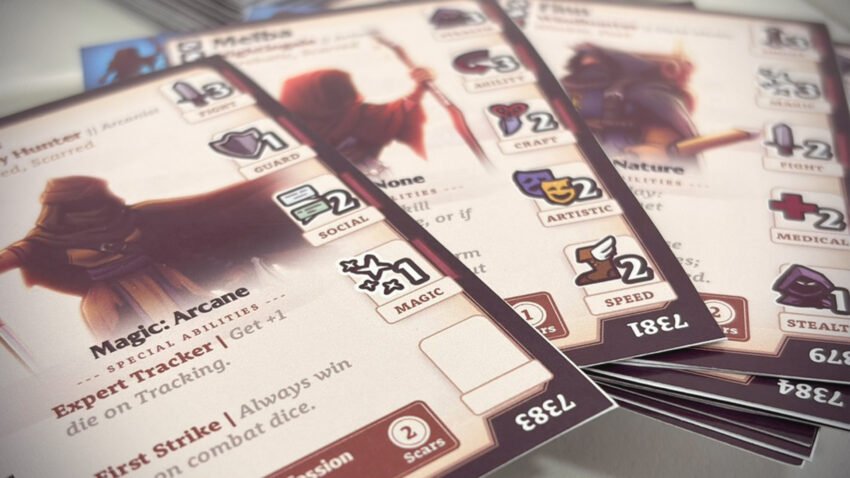
Cards surprised me because they somehow sit in the middle of all of this.
They have the physicality of chess pieces.
The readability of battle maps.
The accessibility of theatre of the mind.
And just enough visual information to spark imagination without completely replacing it.
A card says: “Here is the idea of this thing.”
Your imagination finishes the rest.
At first I thought cards were merely practical. Easy to store. Easy to prototype. Easy to organize. But over time I realized they were doing something emotionally important, too.
They were preserving imaginative space.
The player still has room to wonder.
Room to project.
Room to participate creatively.
Increasingly, I think that participation is where the magic of role-playing games actually lives.
Not in perfect visuals.
Not in hyper-detailed simulations.
Not even in realism.
In symbols.
Simple things that invite the mind to dream bigger.
Maybe that’s why chess is so powerful for me. It feels like war, betrayal, heroism, all in the space of a few minutes.
Simple stone symbols is all it takes.