A Brief History Why I Care About This Subject
I started building my own RPG, Super Maps & Legends (SuperMNL) as a traditional table-top role-playing game in fall of 2023, but my imagination went wild when I thought of the possibilities of digital character generation. Having thoroughly enjoyed the randomness that generated characters provided my Rimworld playthroughs, I knew there was a lot of potential there for not only fun, but a flat-out better RPG experience. I asked my brother Adam for help and he built a character generator in Excel in a few hours based on a spreadsheet I had made. I generated my first 10,000 NPCs and was hooked. At that time, I assumed moving into digital generation of characters required the game to be a digital, virtual tabletop-based game. A physical game just seemed completely unrealistic … how could a GM manage 1,000 characters, much less 10,000?
I Love Digital… But—
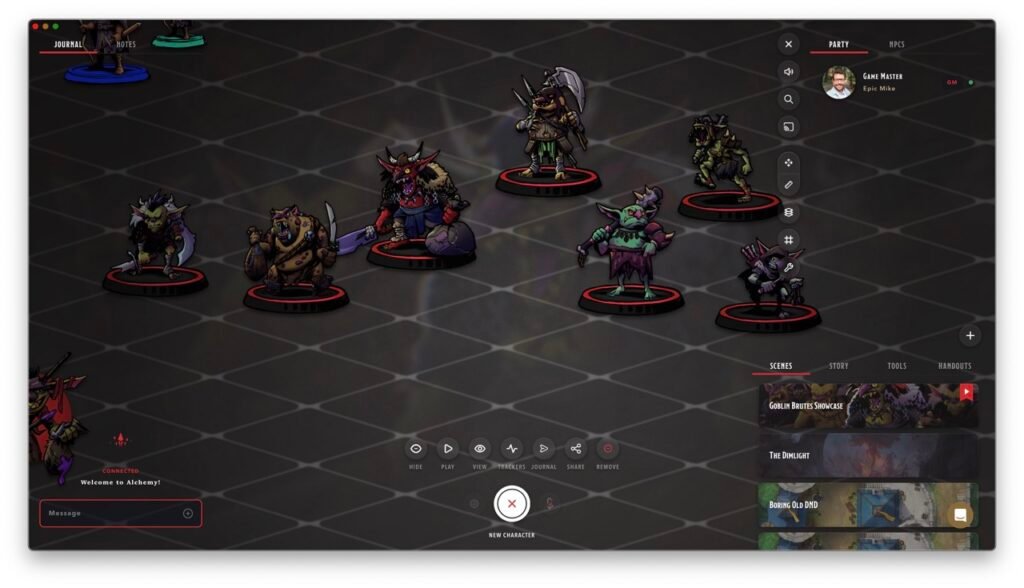
I love Virtual Table Tops. Reconnecting with friends anywhere in the world is priceless, and I have to admit I’ve enjoyed using battlemaps and scene art both as a player and Game Master. VTTs work well for what they are designed for. But when I considered the complexities of 1,000 NPCs in a VTT… they just aren’t built for it. None of them are. They are built for small quantities of NPCs and characters. If I wanted to make a more traditional TTRPG… they would be a great fit. But I still had 10,000 stars in my eyes.
Cards Are An Elegant and Versatile Physical Database
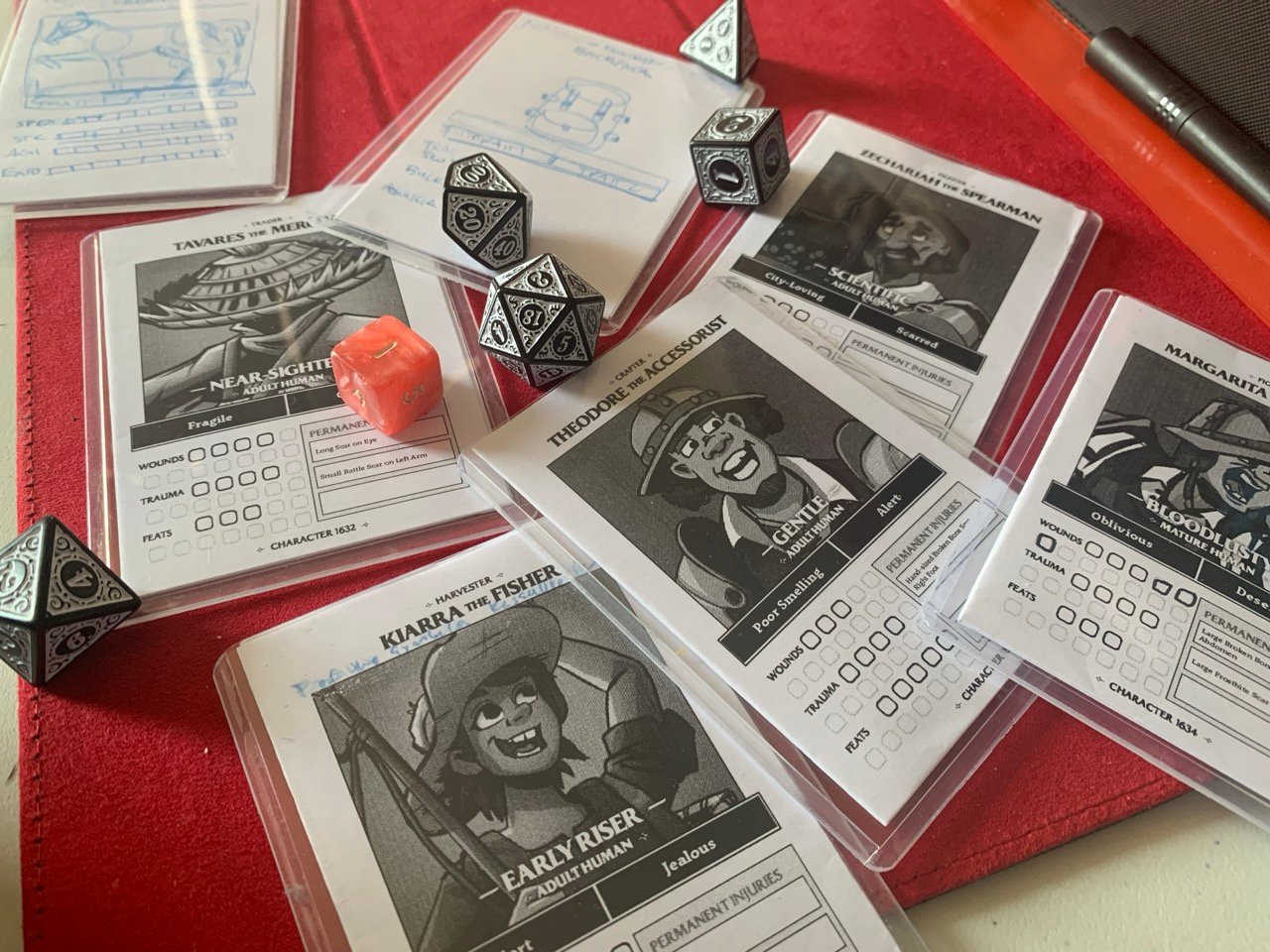
Apples to Apples is a popular party game with 1,000 cards. It’s a database. A randomizable, flippable, stackable, touchable database. And those cards could be NPCs. Or anything you want. It’s compact, portable, and everyone already knows how to use it. But best of all… one card side can be hidden from the players, allowing for a bit of mystery and a new way to explore a world.
In the case of SuperMNL, I’ve used the front side for public info and the back side for private info. The stuff you’d have to spend time talking to someone to find out. And it works beautifully!
Imagine not relying on the GM to describe every minutiae of every character in the world, and instead, being able to just “look” at those around you while your GM describes a scene. “Here are the people in the tavern with you,” says the GM setting out 15 character cards, and then goes on to explain some scene set-up while you take a look. Are they fighters? Commoners? Ruffians? You get to decide not by asking the GM questions about each one, but by looking each one in the face, or if there isn’t card art yet, by reviewing some basic facts such as profession and traits. If you talk to them, the GM has all the tools needed to improv the situation. If you return to that same tavern a year later… the GM can pull out the same cards, and mingle in some new ones if desired. It’s a beautiful and refreshingly simple way to play that adds depth to scenes that normally are limited to a GM’s description. Suddenly, mundane life is a bit more adventurous!
Limitations of Cards
Physical cards certainly aren’t perfect. They aren’t editable or expandable as easily as digital content. They take up a lot of space on the game table. They require card art to work well, and while that can be snazzy, even great-looking cards don’t look as cool as hand-painted minis on a battle map. Cards can be a pain in the butt to store and transport if there’s a lot of them. And they’re not searchable like an online database might be. But cards sure are elegant in their simplicity and fast to set up!
A Few Other Considerations
Setting is Important — and I Don’t Mean Campaign Setting
When I consider the game that I want to play, I envision its ideal play setting. And that’s not on a VTT. It’s in a room with my friends, without laptop or cellphone or bad internet barriers dividing us. That’s the ideal, and a game should, I think, start with the ideal and build out. I’d rather target a new market than abandon the ideal as an unachievable quest.
What’s Best for GMs?
GMs shouldn’t need bazillions of YouTube videos, books, charts, or advice to do their job. I did this job as a 10-year-old that didn’t even have a Dungeon Master’s Guide. A game should have enough tools built-in that a GM that is new, or that’s run out of creative juices, or didn’t sleep, or is kind of sick, or didn’t have enough time to prepare will still do fine. We have bad nights. We’re human. We’re just game hobbyists, not improv professionals. What platform has the best user experience for Game Masters? Let’s use that. Cards get this right. It’s just enough info to be useful and nothing else.
What’s Best for Players?
What is easiest to understand for players? What gets them laughing, crying, breaks down their inhibitions and releases their artistic side? I want to see people gathered around a campfire mesmerized by its dance, not people who have pushed together office desks to have a LAN party. I’ve found cards to be a uniting force. They are big enough that kids can hold them. They can be protected by plastic so even babies can’t destroy them. Parents aren’t worried about miniatures getting mishandled. Older folks can actually see cards from across the table because they’re larger. Cards can be picked up, reviewed, passed around, and replaced easily on the table. Cards have all the identity and gameplay content on them (try that with a mini! Is this Orc mini #5 or #8? I don’t remember…). Cards are just easy, and that’s great for players.
What’s More Hackable?
This hobby is about hacking a game to make it your own. The more complicated a platform and more robust the features it provides, the harder it is for a GM to hack the game, and the more likely the GM is to default to core mechanics and a defined game experience. Feels a bit suffocating to me, and often infuriating when I’ve attempted to hack various online platforms. There’s always barriers that are just annoying. Always. But cards’ bit-sized nature just makes it easy. Oh an earthquake just happened? Well, let’s randomly choose three of these characters that have the building collapse on them. No dice needed, just shuffle and choose. Need a new card? Card blanks are cheap and high quality. Need a reusable card? Dry erase cards are a thing. Want to build a new generation tool? Just build it out of cards. Want to print more cards? We got you covered with online gen tools, even hundreds at a time if needed.
What has more longevity?
How many apps are you still using after twenty years? Let’s face it, if you build a game world in a digital tool, the chances of you building your NEXT game world in the SAME TOOL is not likely because someone will come along with a better app experience.
But Magic cards are still around from the 90s and still being played in the same core game. Printed material lasts. Because a card is only a small piece of bite-sized data — and not the platform/database itself — it really is fairly versatile once printed. A character card printed today for SuperMNL could still be used as a character card in 10 or 20 years. Perhaps some layout has changed, or core mechanics refined, but it would still have the basics: character name, profession, art, some traits to help give the character personality, and of course a few skills. These things haven’t changed for 50 years since the inception of RPGs.
Try exporting your online VTT content and then importing it to a new platform. I seriously doubt that you will have much success. There’s no incentive for any business to give you export options, and import options are so complex they will likely always be limited to D&D and/or Pathfinder and nothing else until AI is so good it can magically make it happen for all the varied systems out there.
Finally, because of all these import/export issues, I truly think that cards will be a better long-term investment, less expensive in the long run for players and GMs, and a better more inclusive platform on which to build a game and a community.
What is Easier for GMs to Keep Organized?
While having 1000s of cards may seem daunting, the reality is they stay organized logically and simply because virtually all role-playing scenes are character-centric. And if that’s the case, just organize the characters by location. Got a big city? A single-row card box with dividers for districts is enough. Anytime the party visits that city, pull out that box. Perhaps a few more dividers for factions or other large groups. In most cases, just put a location card in then all the character cards that pertain to it behind it. Done.
But in a VTT? Organize cards however you want. But will a VTT adapt to your own personal methodology? It’s searchable, sure, but is it truly navigable? When I considered 1000s of characters or locations or heaven forbid horses or other mounts to flush out a world, I really began to understand the power of a card-based database and the weakness of VTTs for that application. For me, cards win on organization.
What platform can do Mounts, Inventory, and Mass Combat best?
These are such unneeded details to include in this list, but for some reason these three subjects are incredibly important to me personally as 5E and VTTs have just kind of failed me here. I’ll do blog posts on these subjects eventually. But cards do all three magnificently because of one main feature that a 2D computer screen really struggles to replicate — stackability. Want to ride something? Just stack two or more cards together. So easy. Are you facing a different direction than your mount or the other people riding your mount with you? Just change the direction of the cards. So easy. Want an army? Just stack 100 characters together. Want to fight two armies? Just shuffle two decks together and then start resolving the fights quickly and simply, like the card game War. The list goes on and on. Cards are great! I’m surprised I haven’t seen them more.
In Conclusion — It’s a Card-based RPG FTW
January 2025 is when I made the shift to remake SuperMNL as a card-based RPG — a decision that I keep trying to find ways to refute, but the choice has stood up strong to the barrage of ifs ands and buts I have thrown at it. Super Maps & Legends may be the first RPGs of its kind, perhaps even a new genre of RPG — the multi-character card TTRPG (please don’t turn that into an acronym, I don’t think “MCCTTRPG” is something anyone wants to actually say!). I haven’t made a list of features in the last year or so, and now is a good time to sum up just how unique the game is becoming:
Features of Super Maps & Legends (Character-focused)
- All the characters and character sheets are card-based (standard trading card size 2.5″x3.5″)
- Each player controls up to 6 characters
- Players don’t make their own characters
- Players can play any character in the game world after an “acquisition” process approved by the GM, which means anyone you meet could become your next favorite character!
- Digital generation tools help GMs expand the characters and places in their world easily, and print them out on a home printer if desired, even en masse
- The game will launch alongside an online repository of artwork for characters called Character Cache, which currently has about 60 characters (with thousands of variants) and once I get it going should be able to expand by about 30+ characters a month. This repository could also be used for other RPGs if desired and while connected directly to SuperMNL will likely be a separate service with a subscription, mainly because endless high quality character artwork ain’t cheap.
- Maybe: It’s possible a card art manipulator/token generator app may be made to help GMs tailor-fit art as much as possible to their game world and use case.
- Maybe: Other gen tools like unique mounts, backpacks, gear, loot, locations, etc. could be a thing.