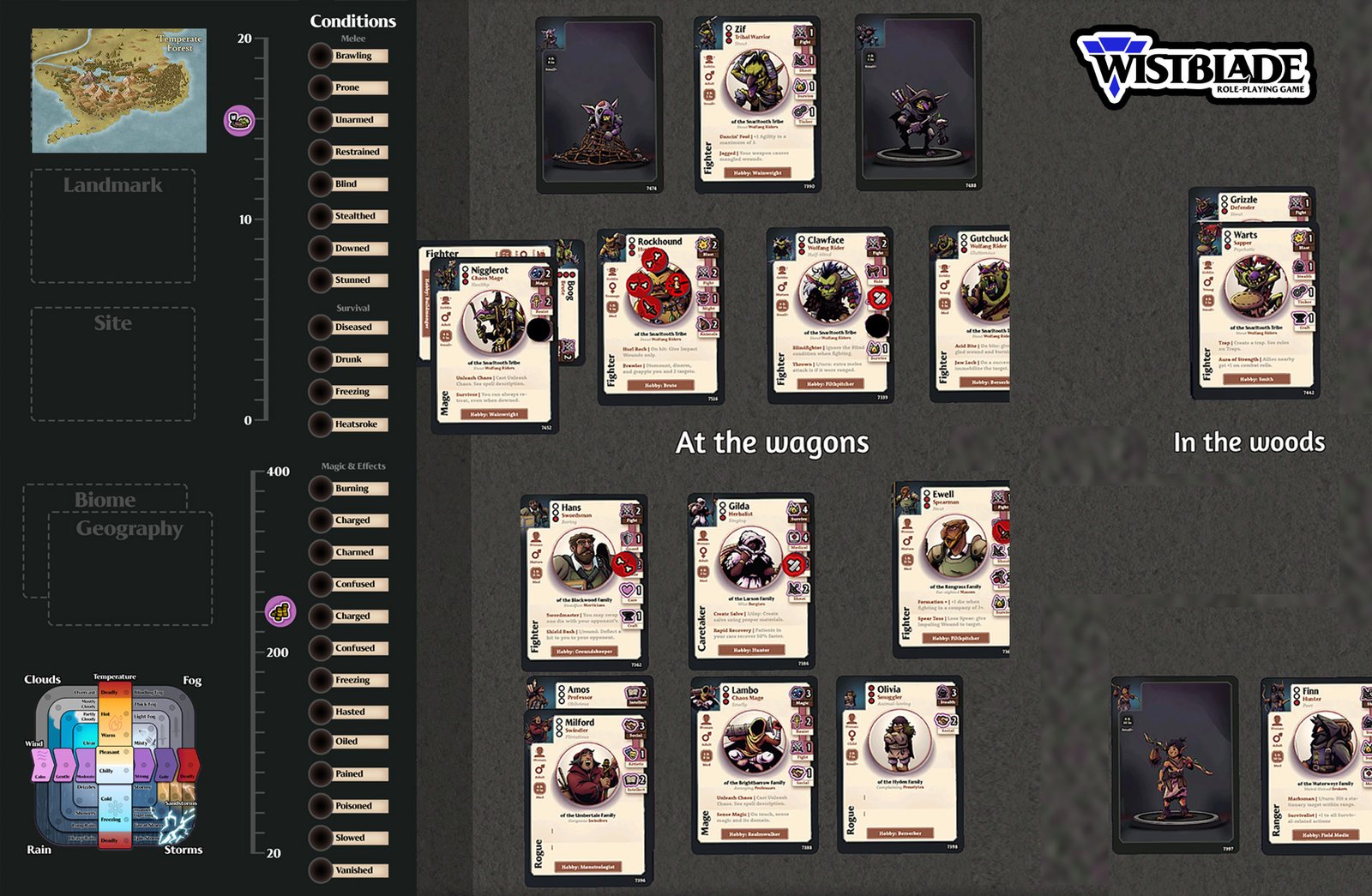
I recently wrote the following as part of the text of Wistblade’s manual:
The Game Master is a director, modifier, and organizer of the chaos created by the game and its players. Wistblade is a fantasy adventure playground: a sandbox engine that generates engaging stories. It’s a scrappy, messy game where scenarios and challenges are discovered in the moment, not read from a book. The Game Master uses generation tools, creativity, and good judgment to provide a roughly painted scene, situation, dialogue, or challenge, and Players’ imaginations fill in the gaps. Wistblade is designed for improv; most Game Masters will find that scenarios can be created in a few moments and improvised with minimal effort. Game Masters always have power to retcon, rewrite, replay, add to, or redo anything they wish at any time if the new course will create more fun in the future.
A fantasy adventure playground is a game where everyone has fun, especially the Game Master. But to achieve a game that expects improv and expects Game Masters to not be stressed is a tall order. How could such a miracle be accomplished?
It’s all about User Experience for the Game Master
If a game could teach a new Game Master everything needed to improv the job organically, the way to achieve it is design everything for that intent alone. Such an achievement by nature would also make the game equally accessible to players and spectators. I needed a seamless user experience at every stage from pre-purchase to running several nights of gaming in a row. Make it easy, but don’t sacrifice depth. If the Game Master is having a good time, everyone will have a good time. Some games attempt to do this by essentially giving the Game Master everything they “need” and telling them exactly what to do; but I was determined to keep the game a sandbox, a game with no purpose, no plot, no end goal, and with a rulebook that was as small and easy-to-use as possible. A tutorial and a little structure, sure, but after that, freedom. How could a game so structureless be easy to run? The secret sauce is relying on the illusion of life.
The Illusion of Life in Cinema
Walt Disney and his team of early artists are world-famous for creating a new genre of art: animation. When defining animation later in their careers, they used the term “the illusion of life.” In animation you could create a character out of anything – a chair, an alligator, a dwarf, a dragon, a princess — whatever. What made it work was the illusion of life – even though it wasn’t real, it acted in ways that seemed plausible, and thus could impact us as if it were a living soul. It’s a step more advanced than written fiction; it incorporates movement, voice, timing, and subtleties inspired by real life. Some of these imaginary characters have risen to the top as among the most heartwarming, touching, and powerful cinematic characters ever. They have been instilled with the illusion of life. They are believable, appealing, lovable. Though an illusion, they touch our hearts forever.
Are role-playing characters any different?
Interesting Choices = Fun
The power of characters that are filled with an “illusion of life” is that they create drama just by co-existing in the same space. And drama leads to impactful choices, which are the heart of engagement (see Questing Beast’s video on this). Thus, Wistblade’s foundation is simply a mass of intriguing characters — easy to bring to life, never the same, beautifully illustrated, and with weaknesses unique to them.
The Lack of Control is one Secret: Inspiration from Rimworld
Anyone familiar with the indie video game hit Rimworld, will know it offers a stress mechanic that results in breakdowns, or a complete lack of control over a character for a time. Players simply have to deal with repercussions of breakdowns after the fact. In my opinion, it’s genius. Why? Because it provides the illusion of life! Losing control over a character implies the character has a will of its own, and will fight back if you abuse or push the character beyond its limits. Wistblade adapts this idea to an RPG setting; when a character has a breakdown, they are returned to the control of the Game Master, and each character has a propensity towards a specific type of breakdown, around 20 or so in total.

Wistblade’s Unique Styling
Beyond Breakdowns, Wistblade rethinks most role-playing mechanics back to their core.
- Why not let players role-play entire groups of people the same way the Game Master does?
- Why not let a single player strategize combat and other problems using more than a single character class?
- Why not have a parent-child relationship instead of an avatar-like relationship with your character(s)? You care for them, help them, and guide them, not project yourself through them into a fantasy world.
- Why not unify game systems like battle, economy, leveling up, and even world building using more or less unified core mechanics?
- Why not make combat unique, impactful, and life-altering like it is in real life?
- Why not include character degradation over time from age, scars, and other consequences? ie, design mechanics for sacrifice beyond death and losing an item or two.
- Why not force players to play pre-existing characters? Love is often discovered in the journey, not designed in advance. Why not also give players the chance to discard and acquire characters?
- Why not provide every character with familial bonds, not just the important ones?
- Why not give more power to the Game Master, such as retconning something they said or did but realized could have been better?
- And much more!
In video games such as Diablo, the point of being a fighter is glory, wealth, and advancement; in Wistblade, the point of being a fighter is protecting someone you love — or yourself — from certain doom. But if doom occurs its not the end. Those who linger on will remember you, perhaps take up your mantle, perhaps raise your children. Each story is unique and ends or continues as seems natural to those characters’ Player. Many details make a difference; even the mount you choose to ride (or not ride) makes a meaningful gameplay difference in Wistblade. Any time you roll dice, the results will likely change someone’s life! I really feel this helps the game create that illusion of life.
Do Role-playing Systems Support or Inhibit the Illusion of Life?
I have kept the “illusion of life” as one of my visionary pillars when designing Wistblade. Does each game system I create support Players and Game Masters in their effort to make characters feel alive? Are the stories generated by the game surprising, balanced, grounded, and adaptable to the game table? Is it still a fun game to play for a wide variety of people? My hope is to answer yes to all of these once I’m done with the game!
Getting Close
Another 3 months have passed and I am closing in on the kill. Creating something new is like hunting a creature you’ve never seen before. I had crossed its tracks periodically, spotted it from a distance, observed it, and now think I understand the creature. I’m ready to go in and execute. I didn’t really set out to create a game quite this unique but that’s kind of where I am headed: an odd mash-up of D&D, Magic: the Gathering, and Rimworld. I’m still not sure it’s possible to do it all; but so far the testing is promising. Imagination, how it works, and why and when to use it I think is key to finding that miracle experience. Until next time!